How Péter Magyar Challenged Hungary’s Electoral Autocracy
A turning point in the political system built by Viktor Orbán and his party.
 Deniz Şener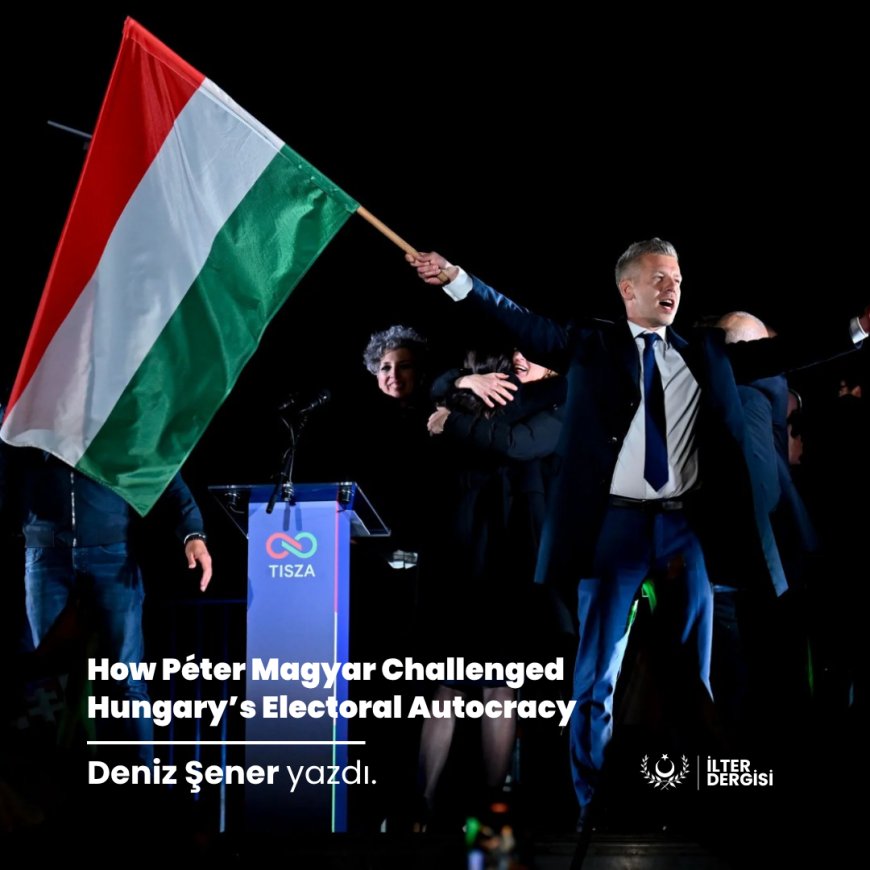
Since 2010, Hungary has been dominated by the political leadership of Viktor Orbán. Following the fallout from Ferenc Gyurcsány’s infamous Őszöd speech, public trust in the centre-left coalition government collapsed, leading to protests in 2006. This crisis of legitimacy paved the way for Orbán’s decisive victory in the 2010 parliamentary elections, where his party secured a huge parliamentary majority. But why has Orbán’s dominance endured since then?
What follows is an examination of the institutional changes introduced by Viktor Orbán and his Fidesz–KDNP coalition since 2010, and how they have reshaped Hungary’s political balance of power toward a right-wing autocratic model.
Constitutional Overhaul and “Cardinal Laws”
Having secured a two thirds majority in Parliament in 2010, the Orbán government immediately began reshaping the state's basic rules. In 2011, the 1989 constitution was substituted for the new "Fundamental Law of Hungary". The key change in the new constitution was the introduction of "cardinal laws," in other words, those covering crucial areas such as taxation, family policy, and the election system. Any revision of cardinal laws requires a two thirds parliamentary majority, thus effectively preventing the opposition to change its ideology even if it wins an absolute majority.
Creating an Unbreakable Electoral System
The most effective way to ensure indefinite rule through the ballot box is to change the electoral law. Between 2011 and 2012, Fidesz unilaterally revised the Hungarian electoral system. The size of the parliament was reduced to 199 seats. Gerrymandering ensured that many districts were dominated by rural conservatives. Moreover, the two-round system was replaced by single-round single-member districts, while retaining a national party-list component. Most importantly, the winner compensation system was adopted, which implies transferring surplus votes for winning candidates to the party list. Under this distorted system, Fidesz obtained a supermajority with only 44.5 percent of the vote in 2014.
Co-opting and Taming the Judiciary
As part of the plan to make his government immune from lawsuits, Orbán successfully co-opted the judicial branch. In particular, the Constitutional Court received additional justices loyal to the ruling party. What is more, it was stripped of the possibility to review laws concerning the central budget or taxation. Lastly, the creation of the National Judicial Office, led by a trusted ally of the ruling party, centralized the control over appointing, promoting, and relocating judges.
Media Consolidation
One of the key pillars of any electoral autocracy is tight control over information. In the last ten years, independent Hungarian media has been denied access to the state funding and bought out by pro-government oligarchs. Finally, in 2018, the “Central European Press and Media Foundation” (aka KESMA) was created. All but about fifty privately owned media companies, including various newspapers, radio stations, and TV channels, became its property. The result is a single channel media that dominates Hungarian society and makes it impossible for opposition groups to be heard.
Abuse and Normalization of Emergency Powers
Traditionally, the Hungarian legislation was changed using the standard process. However, since 2016 when Orbán declared a state of danger because of mass migration, this process has been supplemented with frequent use of emergency powers. In particular, declaring "states of danger" during the COVID-19 pandemic and the Russo-Ukrainian war, the government granted itself the ability to govern by decree. Consequently, sweeping legislative changes can be introduced instantly bypassing any discussions within Parliament.
Strategic Corruption and Clientelism
Finally, the economic supremacy of the Orbán regime is guaranteed by the "System of National Cooperation". Using its control over EU funding and state contracts, the regime builds a new class of oligarchs who are loyal to it. This creates an effective system of clientelism, wherein huge sectors of the Hungarian economy have become completely dependent on the political allegiance of the regime and its leaders for its prosperity.
Intimidation through Institutionalization
In one of the most recent moves in the sphere of political institution-building, in February 2024, the Orbán government launched the “Sovereignty Protection Office”. Having unlimited investigation powers over any organization, political party, or person suspected in pursuing foreign interests and taking foreign funding, the Sovereignty Protection Office is an intimidating instrument aimed at harassing NGOs, investigative journalists, and political opposition.
But even after all these roadblocks, how did one man reshuffle the deck of Hungarian politics? First, let’s get to know Péter Magyar inside out.
Péter Magyar. He wasn’t your typical opposition politician, he was a product of the very system he broke. As the ex-husband of Fidesz’s star Justice Minister, Judit Varga, and a high-ranking executive in state companies, he was the ultimate regime insider. Because he knew exactly how Orbán’s machine worked, his rebellion hit with an authenticity that traditional rivals simply didn’t have.
The first spark of change happened in February 2024. Katalin Novák, then President of Hungary, who had campaigned on family values and the protection of children, did the opposite. She pardoned Endre Kónya, the former deputy director of the Kossuth Zsuzsa Children's Home in Bicske, who was involved in covering up a child sexual abuse case. Judit Varga, then Minister of Justice and Magyar's ex-wife, countersigned the pardon. Magyar? He was not having it.
Péter Magyar, announced on Facebook:
”Today, I am submitting my resignation from my positions at both state-owned companies. I am also resigning from my seat on the supervisory board of the partially state-owned MBH Bank Nyrt. My resignation is not based on professional reasons.
I do not want to be part of a system for even a single minute in which those truly responsible hide behind women’s skirts, where Tónik, Ádám, and Barbara can laugh merrily into their hands while thoughtlessly sacrificing those who, unlike them, never worked for their own financial gain but for the sake of their country and their fellow citizens.
For a long time, I believed in an idea—a national, sovereign, civic Hungary—and for many years I tried, with my own modest means, to contribute to making this a reality. But over the past few years, I have slowly—and now finally—come to realize that all of this is really just a political product, a sugar coating that serves only two purposes: to conceal the workings of the power machine and to amass immense wealth.
I believe that Hungary is not the country of the Antal Rogáns, the oligarchs, or even just a few influential families, but rather the country of the János Hunyadis, the István Széchenyis, the Ignác Semmelweis, the István Bethlens, the Miklós Radnótis, Margit Slachtas, Sándor Márais, the freedom fighters of ’56, the Ludas Matyis, and every decent Hungarian.” (translated and summarized)
From that day on, the days of the Orbán government and the Fidesz-KDNP coalition were numbered.
Since the Orbán government controlled the media, what did Magyar do you might ask?
He bypassed it.
To reach his audience, he used the one thing the government couldn’t control, social media. Magyar reached out to the masses by pulling back the curtain on the corruption inside Fidesz. He didn’t just make accusations, he just spoke like a man who had been in the room where it happened.
He appeared on the independent YouTube channel Partizán, accusing Orbán’s government of corruption and instantly grabbing the nation’s attention. He wasted no time and took over the inactive, already existing Tisza Party to bypass the bureaucracy. He then began traveling all across Hungary. Ideologically, he is a conservative-liberal, which helped him attract traditional rural conservative voters alongside liberals and pro-europeans. He essentially united two rival voter bases into one.
Then came his first test, the European Parliament election.
On 9 June 2024, Hungary had its European Parliament elections. Tisza was about to enter its first election. The numbers came up rather impressive:
Fidesz-KDNP: 44.82 percent (losing 2 seats, 11 in total).
Tisza: 29.60 percent (winning 7 seats from scratch).
DK-MSZP-Dialogue: 8.03 percent (losing 3 seats, 2 in total).
Mi Hazánk: 6.71 percent (won a single seat).
These results proved that Magyar was indeed a serious threat to Orbán’s autocratic government. Magyar kept the pace, joining the pro-European European People’s Party shortly after the election.
His ideological position has remained consistent. On 18 March 2025, the Hungarian Parliament passed a bill that forbids promoting or displaying homosexuality or gender reassignment to anyone under 18. This effectively led to a ban on Pride parades and caused a major scandal among progressives, liberals and within the European Union. Magyar? He didn’t budge, he just stayed silent.
He kept that silence all the way through the most important day in modern Hungarian political history: 12 April 2026. Polls had shown two different outcomes, government-allied polls showed Fidesz-KDNP ahead, while the opposition polls said otherwise. The pace was high, and the turnout was at a historical high of 78.94 percent. (that’s almost 80 percent!) After all of this campaigning and the catastrophic defeat in 2022, this time, it had to be over, right? Let the results speak for themselves.
Tisza
Constituency vote: 3,333,415 (55.26 percent)
Party vote: 3,385,890 (53.18 percent, no swing since new party)
Total seats: 141. (won from scratch)
Fidesz-KDNP
Constituency vote: 2,215,225 (36.72 percent)
Party vote: 2,458,337 (38.61 percent, a 15.52 pp swing)
Total seats: 52. (lost 83 seats)
Mi Hazánk
Constituency vote: 345,252 (5.72 percent)
Party vote: 358,372 (5.63 percent, a 0.25 pp swing)
Total seats: 6. (same as 2022)
Tisza won a two-thirds supermajority. Orbán’s autocratic system absolutely failed him. It favored the opposition with a two-thirds supermajority, enough to overhaul Hungary from top to bottom. Budapest was cheering that night. Magyar said in his victory speech:
“My fellow countrymen! Hungarians! We did it! The Tisza and Hungary have won this election. Not just by a little, but by a lot. In fact, by a great deal. Together, we have ousted the Orbán regime; together, we have liberated Hungary… Our victory is visible not only from the moon, but from the window of every Hungarian home. Whether it’s the smallest mud-brick house or a high-rise apartment building, in a big city or in the countryside, it’s visible from every Hungarian window.” (source)
This time, victory was not only limited to the Moon, and of course, Brussels. But was visible from the window of every Hungarian home. Péter Magyar, with that speech, stood with the Hungarian people.
But hold on, what about the silence that he kept? Well…
After his historic election victory, he declared:
”In Hungary, everyone has the right to freedom of assembly. Period.”
By saying this, he proved he was not like Orbán at all. He showed that he is indeed both a conservative and a liberal.
Thank you for sparing your time.
Árad a Tisza!
Sources:
https://www.nytimes.com/2026/04/14/world/europe/viktor-orban-peter-magyar-election.html
https://www.prospectmagazine.co.uk/world/europe/hungary/73053/between-the-lines-peter-magyars-victory-address
https://www.theguardian.com/commentisfree/2026/apr/15/viktor-orban-defeated-energetic-campaigning-peter-magyar-hungary-election
https://en.wikipedia.org/wiki/2026_Hungarian_parliamentary_election
https://en.wikipedia.org/wiki/2024_European_Parliament_election_in_Hungary
https://www.venice.coe.int/webforms/documents/?pdf=CDL-AD(2011)016-e
https://www.osce.org/odihr/elections/hungary/121098
https://www.amnesty.org/en/documents/eur27/2085/2020/en/
https://www.hrw.org/news/2026/04/14/hungary-new-government-needs-to-restore-rule-of-law
https://rsf.org/en/country/hungary
https://freedomhouse.org/country/hungary/nations-transit/2024
https://www.transparency.org/en/countries/hungary
https://results.elections.europa.eu/en/hungary/
https://www.reuters.com/world/europe/hungarys-orban-sees-weakest-support-decades-eu-vote-opposition-tisza-surges-2024-06-09/
https://www.venice.coe.int/webforms/documents/default.aspx?pdffile=CDL-REF%282024%29006-e
https://www.venice.coe.int/Newsletter/NEWSLETTER_2012_02/1_HUN_EN.html
https://www.venice.coe.int/webforms/documents/default.aspx?pdffile=CDL-AD%282012%29012-e
https://www.reuters.com/world/europe/hungarys-president-signs-law-banning-pride-parade-despite-protests-2025-03-19/
https://helsinki.hu/en/wp-content/uploads/sites/2/2024/04/HHC_Hungary_states_of_exception_20240402.pdf
https://www.reuters.com/article/world/hungary-gives-government-right-to-extra-powers-in-face-of-terror-threat-idUSKCN0YT1DA/
https://www.bbc.com/news/world-middle-east-68264363
https://en.wikipedia.org/wiki/Katalin_Nov%C3%A1k_presidential_pardon_scandal
https://instituteofgeoeconomics.org/en/research/hungarys-electoral-system-constructing-a-system-favorable-to-the-governing-party-and-its-future-prospects/