Turkish History View From Carter Findley
This writing is a short summary and review of historian Carter Findley's book, "The Turks in World History," published by Oxford University.
 Barış Dinçer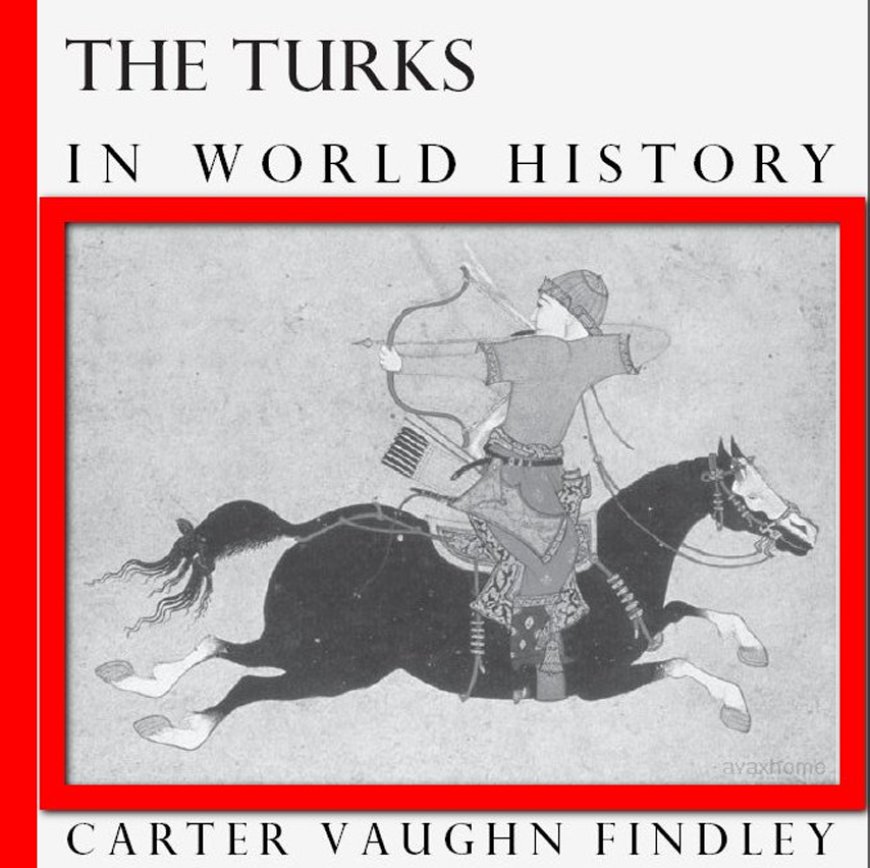
This writing is a analytical essay and little book review of Carter Findley's "The Turks in World History". The book was published from Oxford University in 2005. When evaluating the writing, This is not an absolutely accurate account of history, but rather a brief examination and summary of a historian's interpretive account of Turkish history.
Book examines the Turkish history in three main sections. These sections are Turks before Islam, Turks in Islamic era and Turks in modern world. İn world history The Turks are undergone two major changes. These changes were acceptance of Islam and acceptance of modernity.
Findley says: “The Turkic peoples are famous as empire builders, here again the diversity among them could not be wider. Turks often created or served major empires.”(p.19) One of the main reasons why Turks have frequently established states throughout history may be their language. Citing the French linguist Jean Paul Reux, book says that some linguists believe the unity of the Turkic peoples is most clearly manifested in their languages. Some words that are frequently used in Turkish shows that Turks knew about mining, agriculture, and animal husbandry. These features are not uniquely Turkic, but all of them are of lasting importance among Turks. The wide-ranging similarities across the orally transmitted folk literatures of Turkic peoples are another characteristic that continues to persist throughout history, even as these peoples began to diverge.
The origins of the Turkic peoples are not widely understood. The Turks, or their predecessors, played a significant part in Eurasian history long before their name appeared in historical records. Their Inner Asian homeland was influenced by external historical events. Findley says: “Although linguists hypothesize that proto-Turkic, of which no direct evidence survives, was spoken as early as 3000–500 B.C.E., the Turks did not indisputably appear in history until the sixth century.”(p.21) The state mentioned in this statement may be the Göktürk State. According to sources, the word “Turk” first debuted on the historical scene in the sixth
century. However, according to Chinese sources, people with similar characteristics emerged in the third century. The Xiongnu are largely, if not universally, acknowledged as precursors of the Turkic and Mongol peoples, even though they are not extensively documented enough to provide clear evidence of linguistic and ethnicity ties. The Xiongnu, in turn, inherited a steppe life tradition established in the first millennium BCE. Xiongnu were the first steppe empire, so they are particularly important. The Xiongnu formed a confederation of tribal peoples. As is customary in tribal civilizations, its confederation and even the member tribes
were likely ethnically diverse in origin. The Xiongnu later formed the basis of the Turkic Mongol steppe imperial order. The Xiongnu, especially their governing clans, are believed to have adopted a Turkic or Altaic identity.
According to Findley’s study “From the relations between Türk and Tang to those between the Turkish Republic and the European Union, participation in interregional diplomatic networks and the manifold exchanges that go with them has characterized Turkic states in every period.”(p.40) The system of land grants and dynastic struggles, frequently seen in pre Islamic Turkic empires, was a characteristic of the states founded by Turkic nomads for centuries. This feature was a major reason for the rapid rise and fall of these states. (The Ottoman Empire can be excluded from these states.) According to Findley’s book that the adoption of Islam was the first of two major transformations in Turkish history. This adoption had subjected the Turkish identity to a more drastic change than any that had occurred before or might occur in the future. During the time considerable numbers of Turks converted to Islam, the Qur’anic revelation had begun the growth of a civilization much beyond the essentials. The primary factor influencing the Turks acceptance of Islam was the perception of Islamic civilization as a rich and dynamic one. This was because the Islam that the Turks encountered upon beginning their conversion was highly developed.
According the book, the conversion of the Turks to Islam into three phases. The first phase began in the 9th century with the use of Turks captured during border raids, who had not yet converted to Islam, ghulam in Baghdad or other parts of the Middle East. The second phase begins with Seljuks conversion to Islam in Transoxiana and their migration to Iran. With the migration of the Seljuks to Iran, the admirable history of the Turks as empire builders in the Muslim Middle East began. Seljuk subjects became a significant Turkic presence in the Middle East and certainly created an oral Turkic-Islamic folk culture. The ghulam’s, who were involved in the initial stages, were a key element in the process of state building in the Middle East, but they never managed to create a lasting Turkic presence. “To create an appreciable Turkish presence in the Middle East became the work of the Seljuks.”(p.68) The Seljuks were drawn to Islamic high society due to its diverse aspects, some of which had pre Islamic origins. This led to mutual contact between Islamic and Turkish ideas, particularly in political culture.
The Ottoman Empire was the most striking of Turkish-Islamic empires. In age of Gunpowder, Ottoman Empire was the one that left the most distinct Turkish cultural and demographic mark on the regional empires founded by Turkish dynasties. The Ottomans, whether large or small, understood the intricacies of both Turkish and Iranian-Islamic statecraft through various practices. Despite being a multiethnic state, it strived to prioritize Turkish elements in its culture and administration. The Ottoman Empire was not only Turkish-Islamic state, but also an empire claiming universal legitimacy. Findley explains this with following words: “To Greek Christians, it was the Second Rome; to Slavs, Tsargrad. No longer merely ghazis, the Ottoman sultans now had universal claims to legitimacy.”(p.113)
Modernization was the second major transformations in Turkish History. According to Findley, modernization process of the Turks consisted of two stages: There was a first stage of defensive modernization attempts to stave off the approaching imperialist threat, followed that the second stage is more self confident period in which the European threat subsided, and
the global nature of modernity became clear.
Findley describes the Turks path to modernization as “externally induced modernization.” The late Ottoman Empire had progressed along this path. After 1923, the Republic of Turkey was freed from the threat of colonialism and imperialism and advanced its modernization process accordingly. But this modernization of Turkish republic can not be commented like
mimicry of Western.